

Choose a cat tree for large cats by checking usable platform space, the manufacturer’s weight limits, stability, the climbing route, and how the tree will fit into your home. Overall height is only one feature, and it does not tell you whether a big cat can turn around or settle comfortably. This guide walks through the measurements and buying questions that matter, compares common designs, and explains how to introduce and maintain the tree. Your cat may enjoy acting like the landlord, but the new property still needs a sensible floor plan.
How to Choose a Cat Tree for Large Cats
Large can describe body weight, body length, a broad sleeping posture, or a combination of those things. A long cat may need a bigger resting surface even when they are within a product’s stated weight limit. Two smaller cats using the same platform create another question entirely. Begin with your individual cat rather than treating a breed name or the word XXL as a technical specification.
Record the cat’s current weight from an appropriate reliable measurement, and consider the space they occupy while resting naturally. Do not stretch the cat out or try to hold them against a tape measure for a shopping project. A photograph of their usual resting position beside a known-size object can help you compare proportions without handling them unnecessarily. If their weight or mobility has changed unexpectedly, discuss that with a veterinarian rather than treating it only as a furniture-sizing issue.
A useful perch is part of an appropriate environment, but no particular tower design is mandatory for every cat. Ohio State’s Indoor Pet Initiative discusses elevated locations as opportunities to observe and feel secure. Your job is to find a safe, usable arrangement for the cat you have. A low, broad platform can be a more thoughtful purchase than a tall structure whose upper levels the cat cannot comfortably reach.
Read the Measurements That Marketing Photos Hide
Start with the resting surface rather than the overall product height. Ask for the internal dimensions of each bed, platform, and enclosed space, including any rim that reduces usable room. A round bed’s outside diameter may include thick padding that the cat cannot actually lie on. Similarly, a large-looking enclosure can have a much smaller doorway or a cramped internal floor. These are separate measurements and should be treated as separate buying questions.
Next, compare the base footprint with the full space occupied by the assembled tree. Baskets, steps, platforms, and toys can project beyond the base, so the product may need more room than its floor rectangle suggests. Mark both the base and any overhang on a simple sketch. Remember the nearby door swing and your own walking route. An excellent-looking tree becomes less appealing when it prevents you from opening a wardrobe or cleaning the window.
Finally, inspect the climbing sequence between levels. Product photographs often emphasize the front view, while a side view or assembly diagram better reveals where a cat can place their paws. Look for a workable route in both directions. A large upper bed is not enough if the only approach requires squeezing past an obstruction or making an awkward turn. Ask the seller for the missing diagram instead of assuming the hidden side must be fine.

| Check | What you need to know | Common misunderstanding |
|---|---|---|
| Resting platform | Usable internal width and length | Outside size includes thick edging |
| Weight limit | Per-cat, per-platform, or total limit | A total limit is treated as a single-cat rating |
| Footprint | Base and projecting parts | The base size is treated as the entire footprint |
| Access | Routes up and down | A large top bed is assumed to be easy to reach |
| Installation | Assembly and anchoring requirements | An anti-tip kit is treated as optional decoration |
| Maintenance | Cleaning and replacement instructions | The initial appearance is assumed to last without care |
Separate Weight Limits From Stability Claims
A capacity figure must be read in context. Check whether the manufacturer is describing the whole structure, a particular bed, a hammock, or an individual cat. Several lighter cats within separate limits are not necessarily equivalent to one heavier cat using the same attachment point. If the listing is unclear, ask for clarification before buying. Do not calculate a new single-cat allowance by dividing or combining figures that were not designed for that purpose.
Stability also depends on assembly and the intended installation surface. Follow the supplied instructions, use the required fixings, and fit an anti-tip system when the manufacturer specifies one. A review saying another household skipped the anchor is not an alternative installation instruction. If the necessary fixing cannot be installed properly in your home, choose a different suitable design rather than quietly treating the requirement as optional.
Consider the tree’s location before assembly begins. Uneven flooring, a loose rug, or a cramped corner can create practical problems even when a product has a substantial base. Check that the assembled structure sits as intended and that the surrounding route remains clear. A wall nearby does not by itself establish that the tree is securely anchored. Installation needs to be correct, not merely close to something that looks supportive.
Compare the Main Cat-Tree Styles
A tall multi-level tower can provide several destinations, but every platform and connection still needs to suit the individual cat. A lower tree may use more floor space while offering easier access to a broad resting surface. Wall-mounted furniture can free some floor area, but introduces different installation requirements. These are design tradeoffs, not a ranking in which the tallest option automatically wins.
For a cat who primarily wants to rest near people, start with the quality and position of the main sleeping surface. For a cat who enjoys exploring higher locations, inspect the whole route and the available destinations. Our cat enrichment ideas can help you identify which opportunity is missing before choosing the furniture that provides it. A tree should earn its place by serving a real use, not simply by having more components than the previous model.
In a multi-cat home, several platforms can be helpful only if the cats can actually access and use them comfortably. Notice whether a narrow route forces animals into close contact or whether one favorite location becomes difficult to share. FelineVMA’s environment guidance highlights the importance of appropriate resources and arrangements. More beds in a product description do not automatically mean the home has more genuinely usable choices.
This specific Feandrea listing is included as a design example, not as a hands-on recommendation or a claim that it is the best cat tree for large cats. Its height should be considered alongside the usable beds, access, and stated limits. Product variations can change dimensions and fittings, so compare the configuration you are actually ordering. We do not publish a static price or rating because those details change and do not answer the fit questions.
If your main goal is a comfortable lookout rather than a whole climbing tower, compare a tree with the options in our window-bed buying guide for cats. It covers usable bed space, window compatibility, mounting requirements, and access, so you can choose the arrangement that fits the room and the cat.
Assess the Scratching Areas Separately
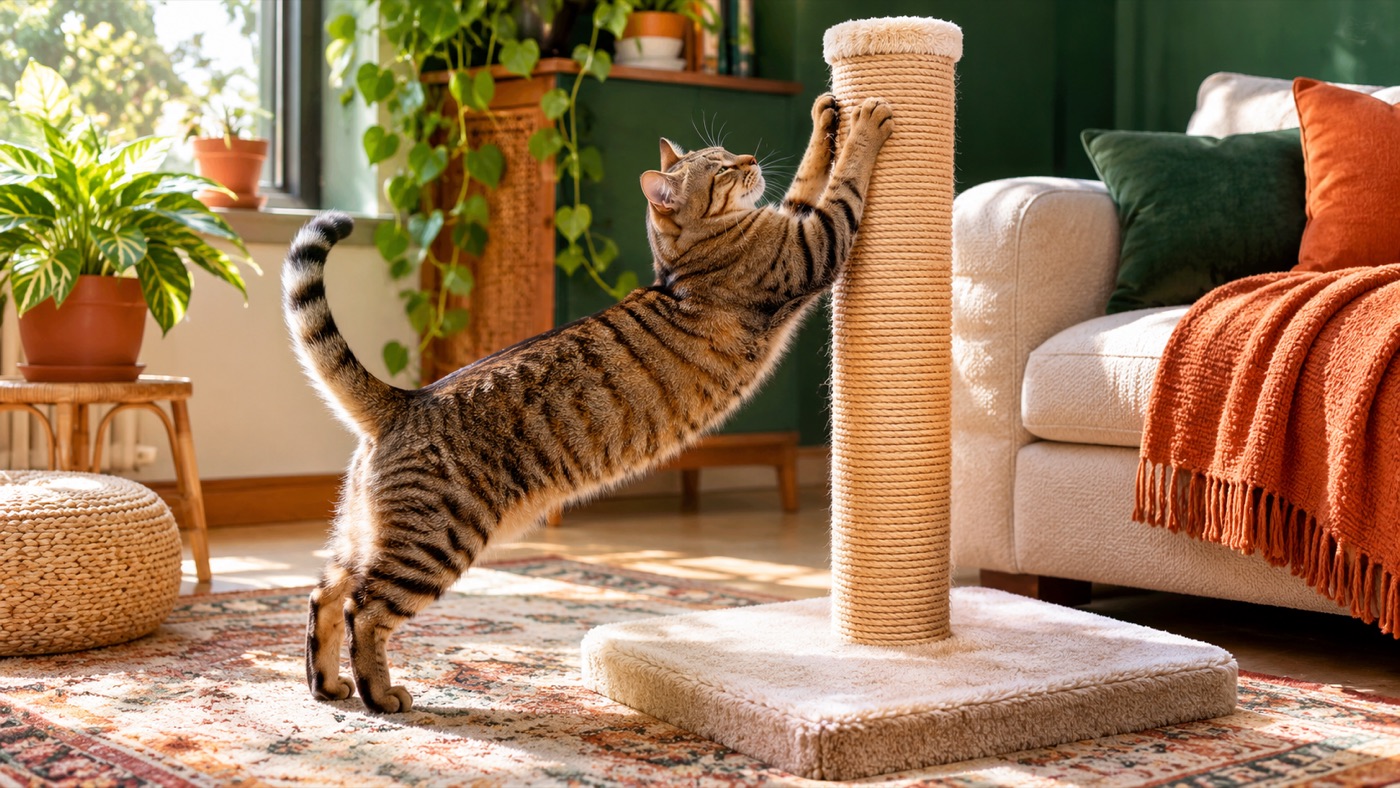
A tree can be an excellent resting resource while providing only a limited scratching surface. Platforms and connecting sections may interrupt the length of a column, and several short covered posts do not necessarily offer one comfortable full stretch. Compare the usable scratching section with the movement your cat already chooses. For a vertical scratcher, Cats Protection emphasizes a sturdy surface with enough room to stretch.
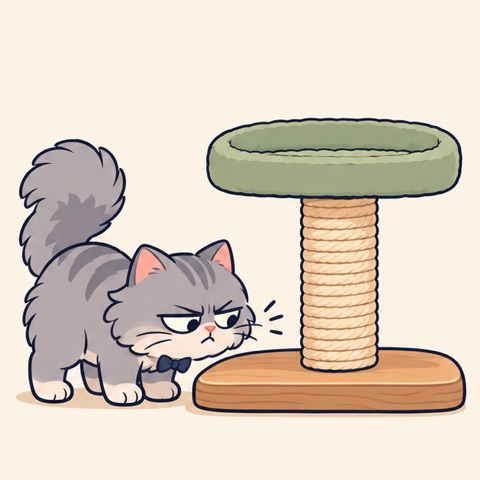
Notice whether the surface is actually available once beds and other components are installed. A column partly hidden behind a large basket may not work the way a front-facing product photograph suggests. Consider keeping a separate suitable scratcher if the tree’s main job is climbing or rest. Our furniture-scratching guide explains how direction, texture, and location influence that separate decision. One object does not have to perform every cat-care job equally well.
Choose a Location Before Choosing a Color
A tree that fits physically may still be poorly positioned for the activity you want it to support. A view, a comfortable resting area near household activity, or a quieter retreat each suggests a different location. Watch where your cat already spends relaxed time and use that as a starting point. Keep the cat’s preferences in the decision instead of reserving the least convenient corner simply because the tree matches the curtains there.
Check windows, doors, radiators, cords, and nearby shelves. A raised platform can change which objects the cat can reach, including objects that were previously out of the way. Cornell’s play-safety advice includes considering falling objects and unsafe surroundings. Review the room from the new platform’s height rather than only checking the floor around the base. Keep windows secure and remove hazards before encouraging exploration.
Think about the people who share the room as well. You need enough space to inspect the tree, remove washable components, and follow the maintenance instructions without dragging it repeatedly across the floor. If the only workable position blocks a regular route, reconsider the design. A less complicated tree in a sustainable location can be more useful than an impressive tower that the household keeps moving out of the way.
Inspect Cleaning and Replacement Options
Soft coverings can look inviting in a new product photograph, but their care requirements deserve attention before purchase. Check which parts can be removed, which can be washed, and which require a different cleaning method. A removable cover is only convenient when it can be removed and refitted as instructed. Confirm whether replacement parts are available for the exact model rather than assuming every item sold by the same brand is interchangeable.
Compare maintenance with your actual household routine. A tree used by several cats may need more frequent attention than one occasionally used as a window perch, and individual cats interact with coverings differently. Keep the manufacturer’s instructions somewhere you can find them after assembly. Record the model name and configuration at the same time. Future you should not need to identify a worn-out hammock by searching old photographs of the living room.
Inspect the structure for loose connections, damaged scratching material, exposed staples or fasteners, and parts that no longer fit correctly. Remove access when damage makes an item unsafe, and use the manufacturer’s repair or replacement guidance. Improvised repairs can change how a component carries weight, so do not assume that any replacement screw or piece of rope is equivalent. If appropriate parts or instructions are unavailable, that limitation belongs in the replacement decision.
Introduce the Tree Without Forcing a Review
After correct assembly and installation, let your cat investigate at their own pace. Keep familiar resources available rather than expecting the new object to replace every existing resting place immediately. The cat may choose the lowest level, inspect the base, or leave the entire structure alone at first. None of those responses requires lifting them onto the highest bed to demonstrate what your money purchased.
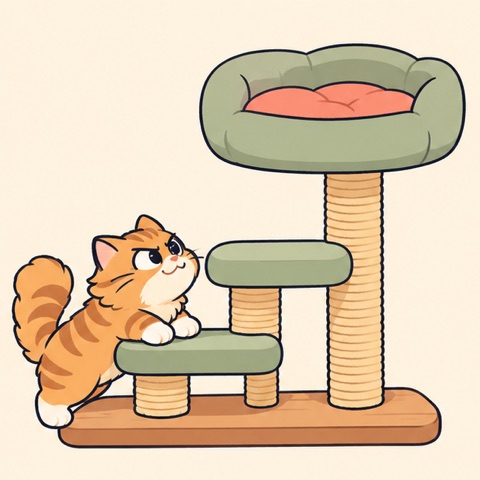
Use an appropriate voluntary invitation, such as a familiar supervised game nearby or a reward for approaching, without making access difficult or taking away choices. Observe which parts are actually used. If the cat repeatedly avoids one route or cannot settle comfortably on a bed, reassess the fit rather than trying to persuade them through inconvenience. A tree is furniture for an animal with preferences, not an assignment the cat has agreed to complete.
A change in willingness to climb should also be considered in context. A cat who previously jumped comfortably and now hesitates may need veterinary assessment rather than a more exciting invitation. Blue Cross’s indoor-cat guidance is a useful broader resource for thinking about appropriate opportunities. Match the environment to the individual, and get professional advice when you are unsure whether the difficulty is preference, access, or a health concern.
A Buying Decision You Can Explain
Before ordering, write a short reason for the purchase that names the actual need. For example, “A broad resting surface near the living-room window, with a manageable route and suitable weight limits,” is more useful than “the largest one in the sale.” Compare two or three candidates against that same sentence. When a feature does not help meet the need, it does not deserve extra influence simply because it photographs well.
Check the seller, delivery details, returns process, and exact variation before paying. Large assembled furniture can be awkward to package again, so read the relevant conditions while the purchase is still hypothetical. Keep the listing information and assembly instructions for the model received. If the delivered parts or dimensions do not match what you ordered, resolve that with the seller rather than improvising an installation to make the product usable.
Cat Tree Questions for Bigger Cats
These questions help distinguish genuine fit information from marketing shorthand. They cannot replace the specifications and instructions for a particular model, so confirm details with the manufacturer whenever the listing leaves room for doubt.
Does XXL Mean It Will Fit My Cat?
No standardized promise follows from the letters alone. Compare usable resting areas, entrances, access, and the relevant weight limits with your cat’s needs. Different manufacturers can use the same size label for very different structures. Treat the label as a way to find candidates, then make the decision from the measurements and instructions.
Is the Tallest Tree the Best Choice?
Height can provide an opportunity to perch, but it does not establish comfortable beds, suitable access, or correct installation. A lower design may better match the cat’s mobility and the available space. Start with the use you want the tree to support. Choose height only as part of the overall fit rather than as the score that decides the whole purchase.
Can One Tree Replace All Other Resources?
A tree may combine several useful features, but the home still needs appropriate arrangements for feeding, drinking, toileting, rest, and play. Review those resources separately instead of assuming a product with many components completes the environment. Our litter box setup guide covers another resource that deserves its own location and access decisions. The useful result is a home that works for the cat, with or without a towering centerpiece.
Buy for the Cat, Then Enjoy the Furniture
A well-chosen cat tree for large cats offers appropriate space, clear limits, usable routes, and an installation you can maintain correctly. Measure before ordering, compare the exact variation, and keep comfort and access ahead of a dramatic height figure. Watch how the cat uses the finished arrangement and respond to practical problems rather than defending the purchase. The best compliment may be an uneventful afternoon nap on a platform that fits, which is a perfectly respectable return on thoughtful shopping.