

A window bed for cats is essentially a front-row seat to a television channel run entirely by birds, delivery drivers, and one suspicious leaf. The right one gives your cat a comfortable place to rest and watch; choosing it well means checking the cat, the window, and the mounting system before admiring the fabric. Start with usable sleeping space, a compatible installation method, an appropriate weight rating, and a safe route up and down. This guide helps you compare those details without treating a cute listing photo as an engineering report or assuming every cat wants the same view.
Choose a Window Bed for Cats Who Love a View
Watch where your cat already settles when the room is quiet. Some sit upright on a chair back, while others disappear into a cushioned bed with only two ears left on duty. Those observations can help you choose between an open platform, a fabric hammock, and a more enclosed resting shape. You are buying for your cat’s preferred way of using a space, which may have surprisingly little in common with the coordinated version of your living room.
A comfortable observation spot also needs to feel accessible and secure. The Feline Veterinary Medical Association’s environmental-needs guidance includes safe resting places and separated resources as part of a cat-friendly home. A beautiful perch in a contested corner may offer less practical value than an ordinary, easy-to-reach bed elsewhere. Treat the window seat as another choice in the home, rather than the only place your cat is expected to rest.
For a cat who mainly wants height and a view, a floor-supported tree beside the window may do the job without attaching anything to the glass. Our cat-tree guide for large cats explains usable bed space, climbing routes, and stability checks. Comparing that option early can save you from trying to make an unsuitable window work. The best purchase decision occasionally looks like removing an item from the cart.
Compare Mounting Styles Before Comparing Cushions
Different mounting systems ask different things of your home. A suction-mounted bed needs the compatible glass area specified by its manufacturer, while a sill- or bracket-mounted design depends on the particular support and fixing arrangement in its instructions. A freestanding bed or tree uses floor space instead. None of those labels, by itself, proves that the exact product fits the exact place you have available.
| Option | Useful When | Check Before Buying |
|---|---|---|
| Suction-mounted window bed | The product’s specified smooth glass area is available | Pane size, permitted surfaces, all suction points, maintenance access and weight rating |
| Sill- or bracket-supported perch | The manufacturer-approved sill or frame fixing is possible | Support dimensions, suitable hardware, installation permission and the full instructions |
| Bed on an existing broad, secure resting surface | The surface already provides a safe accessible position | Usable area, movement of the bed, fall route and window security |
| Floor-supported cat tree beside a window | Glass mounting is unsuitable or floor support is preferable | Stable base, usable perch size, anchoring instructions and an easy climbing route |
Renters should distinguish a product that does not require drilling from one that is suitable for their particular window. Those are separate questions, and a landlord’s permission does not establish glass compatibility. Read the manual before purchasing so you understand every contact point and support requirement. If a product listing is vague about the mounting arrangement, ask the manufacturer for the relevant instructions before your cat becomes the installation consultant.
Be equally careful with descriptions such as universal, heavy duty, or extra large. These phrases cannot replace dimensions, a mounting diagram, and a clearly stated capacity for the model you are considering. Save the exact product name or model number when comparing options. Similar photographs can hide meaningful changes in how a perch attaches, how much room it needs, and which replacement parts it accepts.

Measure the Window, Then Measure the Nap
Measure the actual clear area on the pane where the fixing points would sit. The overall width of the window frame is not necessarily the width available to the product. Handles, dividers, locks, trim, and the route of a blind can all affect the usable arrangement. Make a simple sketch with the contact points from the instructions, and compare that sketch with the window before ordering anything.
For an example of why model details matter, K&H’s EZ Mount Kittyface Window Bed page specifies a solid glass pane at least 27 inches wide and 11 inches high. A different K&H cordless window-perch model lists different minimum space requirements. Do not transfer the smaller measurement to whichever product happens to appear next in your search results. Check the current manual for the actual model and version you will receive.
Next, think about your cat’s resting footprint. Look at a bed or resting place they already use, including whether they curl tightly or stretch sideways with their paws extended. Compare that usable space with the proposed sleeping surface rather than the outer product frame. A cardboard outline placed safely on the floor can help you visualize the footprint, although it cannot tell you whether the finished mounting system will be suitable.
Consider the entry as well as the bed itself. High sides may be cozy for one cat and an awkward obstacle for another, especially when the bed is approached from a small stepping surface. Your cat should have room to turn and settle in a way that suits their body and movement. A listing that calls a bed spacious has not yet met the individual who sleeps diagonally across your entire pillow.
Read the Weight Rating Carefully
Check the manufacturer’s capacity for the complete installed product, including any conditions attached to that claim. K&H lists support up to 50 pounds for the Kittyface example, but that is a product specification under its required setup, not a guarantee for any pane, any installation, or any group of cats. We have not independently load-tested it. Follow the exact instructions and ask the manufacturer when the intended use is unclear.
Think about which cats can actually reach the bed, rather than which one you intend to use it. A second cat does not understand the reservation system you invented while shopping. Where sharing is possible, assess the intended total load and whether the model allows that use; do not assume a single-cat picture answers the question. Separate resting options can also reduce the need for every cat to compete for the same sunny spot.
Inspect capacity and usable size together. A bed can have an impressive stated load rating while still providing too little room for your cat’s usual sleeping posture. Conversely, a broad-looking photograph does not establish the fixing strength. Keep these as two separate boxes in your decision process so one reassuring number does not distract from an uncomfortable or incompatible setup.
Install for the Real Window, Not the Product Photo
Read through the installation and care instructions before unpacking the bed onto a busy floor. Identify every component, the permitted surface, and the checks required before use. Keep your cat elsewhere while you assemble and mount it, so a curious paw is not helping before the setup is ready. Follow the manufacturer’s sequence instead of borrowing a shortcut from a different model’s video.
For suction-mounted designs, the contact surface and the condition of the cups matter to the installation. Follow the cleaning, preparation, and mounting directions for that model, and ask about any film, coating, texture, damage, or other surface detail the manual does not clearly address. The goal is compatibility with your real window. A successful-looking attachment for a few seconds is not a substitute for completing the specified setup and pre-use checks.
Read the care requirements as part of the buying decision, because you will need to reach those fixings again. K&H’s replacement suction-cup guidance recommends regular cleaning of the window and cups and distinguishes several cup types for different positions and products. That makes maintenance access and correct replacement parts practical requirements. A perch you cannot comfortably inspect is not a convenient perch to own.
A Window Bed Does Not Make an Open Window Safe
Sort out window security before giving your cat a new reason to spend time there. The ASPCA’s window-safety advice explains that cats can fall accidentally and recommends snug, sturdy screens when windows are opened. It also warns that childproof window guards are not a substitute for pet protection. A perch’s mounting system supports the perch; it does not secure an opening beside it.
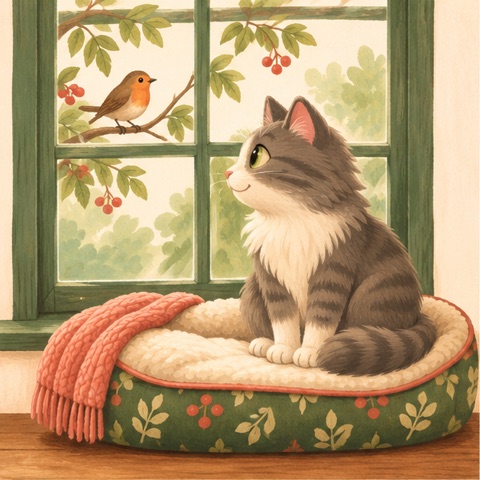
A fully closed window is a straightforward starting point for the observation spot shown in our illustration. If you plan to open it, first check the opening, the screen or protective system, and the possibility of the cat reaching around the bed. Keep blind and curtain cords out of the cat’s reach, and avoid creating a new route to an otherwise inaccessible hazard. The interesting view should stay a view rather than becoming an exit.
Look around the whole landing area too. Remove fragile objects and check whether the approach brings the cat beside a hot appliance, an unstable table, or a busy doorway. Make sure someone can still operate the window or blind safely when the bed is in place. A good setup fits the ordinary use of the room, including the parts that happen when nobody is admiring the cat.
Build an Easy Route to the Best Seat
Think about the journey down as carefully as the journey up. International Cat Care’s home-environment guidance describes how steps or ramps can help cats with compromised mobility reach favorite resting places. A secure intermediate surface can make a low resting position more accessible, but the appropriate height and arrangement depend on your cat. Seek veterinary advice when jumping or movement has changed rather than treating a new bed as a fix for discomfort.
Let your cat investigate voluntarily after the product is fully installed and checked. An optional familiar resting pad may be useful only if the manufacturer permits it and it does not interfere with the fit or the cat’s footing. Avoid repeatedly placing the cat onto a bed they are trying to leave. You are offering a pleasant new choice, not conducting a compulsory tour of the upholstery.
Keep other resting places available while you learn how this one works for the cat. That makes it easier to see whether the bed is genuinely chosen and whether a different time of day changes its appeal. Our cat enrichment guide treats observation spots as one part of a more interesting indoor environment. Play, quiet retreats, and comfortable resources elsewhere still matter after the window bed has earned its first nap.
Choose a View That Your Cat Enjoys
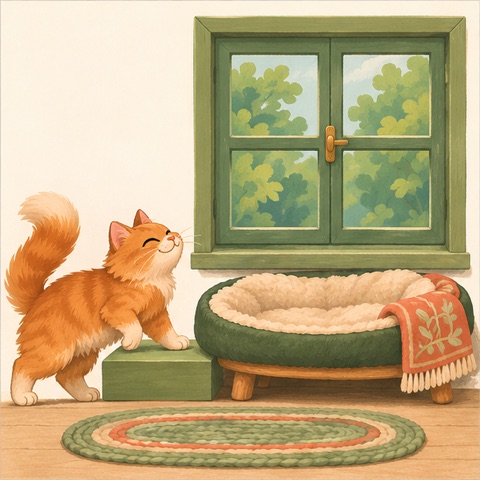
A busy view can be interesting without being relaxing for every cat. AAHA’s behavior guidance describes how an aroused cat watching an outside animal can redirect aggression toward someone nearby. Watch how your cat responds rather than assuming the busiest window is automatically the best one. If the view repeatedly produces distress or unsafe interactions, choose a calmer position and seek appropriate advice.
You might discover that the quiet side window is preferred to the one overlooking the neighborhood’s busiest feline intersection. That is a perfectly useful result even if you personally find the driveway more entertaining. If scratching around a window or nearby carpet is part of the picture, our guide to cats scratching carpet helps you observe the context and provide an appropriate outlet. The location of damage is a clue to investigate, not a diagnosis on its own.
Make Maintenance Part of the Routine
Use the manufacturer’s schedule and instructions for the fixings, frame, pad, and cover. Check for wear or changes in fit, and take the bed out of use if a component needs attention. Cleaning a removable cover and checking a mounting point are different jobs, so avoid letting a fresh-looking cushion stand in for a complete inspection. A tidy bed can still need a hardware check.
Keep the model details somewhere accessible for ordering the correct replacement parts. Record the name and version from the instructions rather than relying on a photograph from your order history. If you move the bed, treat the new position as a fresh installation with its own compatibility and access checks. The fact that it fitted the previous pane does not tell you whether it fits the next one.
Questions Before You Buy
Are Suction-Mounted Window Beds Safe?
Suitability depends on the exact product, its permitted mounting surface, correct installation, load conditions, and ongoing care. A product category cannot provide a universal safety guarantee for every home. Read the manual and use another arrangement when your window cannot meet it. A floor-supported alternative can still provide an excellent view.
What if My Cat Ignores the New Bed?
Check the route, the usable space, the time of day, and whether the location feels comfortable to the cat. Let them investigate without pressure, and compare their actual choices with what you expected. An unused bed does not prove the cat needs a higher or more expensive one. Sometimes the preferred seat is already in the room, quietly costing you nothing.
Can Two Cats Share One?
Check that the manufacturer permits the intended use, then consider the combined load, usable space, and the cats’ relationship. A capacity claim does not guarantee two cats will be comfortable resting together. Separate beds may provide more useful choices than one crowded platform. Watch the household rather than turning the bed into a queue with whiskers.
Buy the Fit, Then Enjoy the View
A good window bed starts with a compatible window, enough usable room, a suitable mounting system, and a route your cat can manage comfortably. Add correct installation, maintenance you can actually carry out, and a view the cat enjoys. Those practical details make the difference between a thoughtful purchase and a very cute item waiting to be returned.
Keep the decision pleasantly specific: this cat, this bed, this window, these instructions. That approach leaves room for a suction-mounted cradle, a supported perch, or a sturdy floor-based alternative without pretending one design suits everyone. Once the setup earns your cat’s approval, you can enjoy the important part. Someone finally has time to supervise that suspicious leaf.